

In today’s research environment, every minute and every data point matter.
Vivarium teams are under increasing pressure to do more with less—especially as government funding tightens and laboratories look for smarter, leaner ways to sustain operations.
For many facilities, the census process is a clear opportunity for improvement.
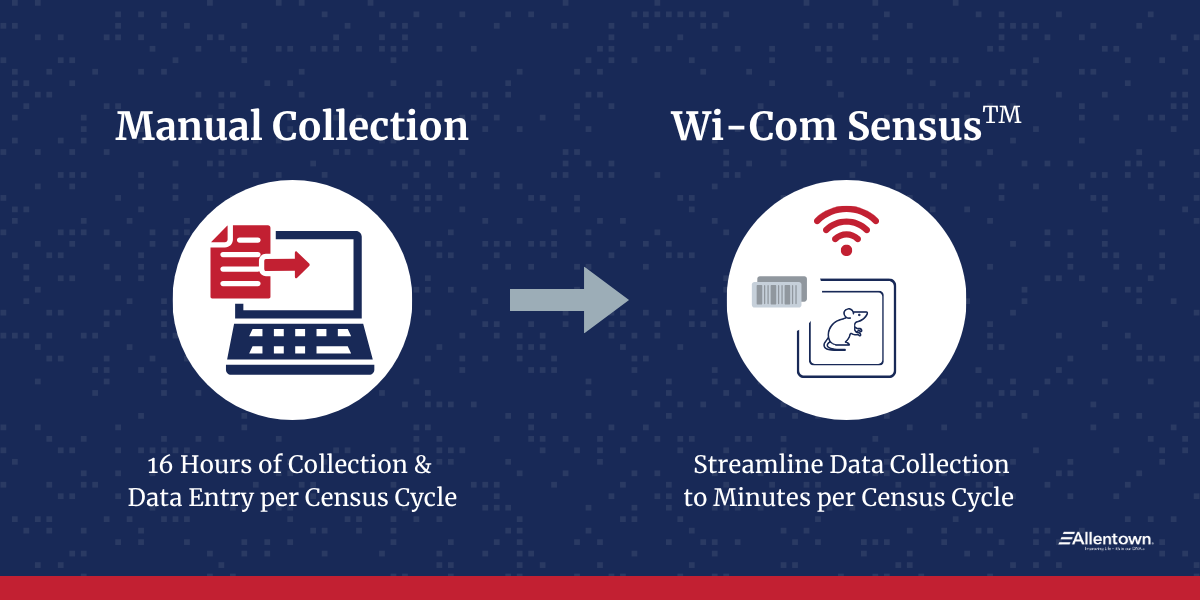
Manual census collection is time-consuming and prone to errors. Barcode systems help, but line-of-sight issues can slow the process. These inefficiencies consume valuable technician and administrative time that could be devoted to animal care, compliance, or research support.
That’s why many leading institutions are integrating radio frequency identification (RFID) technology into their census procedures. By incorporating RFID-enabled tools into existing workflows, teams can streamline operations, reduce manual effort, and achieve more accurate results.
Allentown’s Wi-Com Sensus™ was built for this purpose—helping vivarium managers, technicians, and administrators capture precise cage-level data in real time.
The result is a vastly more efficient census process that costs less per cycle, strengthens operational confidence, and frees up staff to focus on the work that truly drives research forward.
How RFID Scanning Improves Workflow and Animal Welfare
In the vivarium, RFID scanning changes how census work feels and flows. Unlike barcode systems that require line-of-sight, Allentown’s Wi-Com Sensus can read multiple cage cards at once—even those out of view.
Technicians can scan rooms in minutes with minimal disturbance, completing rounds faster and more comfortably, while animals experience fewer interruptions.
“The implementation of this RFID cage card scanner and program has significantly enhanced our operational efficiency in two critical areas: administrative processing and in-room data collection.”
— Dr. David W. Brammer, DVM, DACLAM
Facilities nationwide are seeing similar results as RFID-enabled census collection becomes standard practice.
Case Study: How a Major Research University Streamlined Its Vivarium Census Process
When the research division at a major U.S. University set out to modernize its census process, it replaced manual clipboards with an RFID-enabled workflow integrated into its Laboratory Animal Management and Protocol System (LAMPS).
Allentown and Key Solutions Inc. helped the university implement cage-level RFID tracking that feeds reliable, real-time data directly into its management platform.
The result?
Faster reconciliation, fewer errors, and more reliable billing and reporting—proof that RFID technology is transforming how research facilities manage census and compliance data.
Benefits of Integrating Technology into Vivarium Census Collection
By replacing manual tracking with RFID-enabled accuracy, facilities gain:
- Speed: Reduce census collection from hours to minutes.
- Accuracy: Capture live data efficiently, minimizing errors.
- Care: Complete scans without unnecessary animal disturbance.
- Simplicity: Easy to learn, easy to use, and scalable for any facility size.
For vivarium teams, Allentown’s Wi-Com Sensus improves productivity and morale. For leadership, it provides a transparent, data-driven foundation for confident decisions.
How Wi-Com Sensus™ Integrates with Allentown’s Housing and Digital Systems
Wi-Com Sensus™ is part of Allentown’s integrated family of vivarium solutions—designed to work together for greater facility insight and efficiency.
When paired with housing systems such as Discovery IVC™, NexGen MAX™, EasyCage®, and FlexFlow®, census data can be captured directly at the rack or room level, giving managers a clear picture of occupancy and resource use in real time.
Sensus™ also complements Allentown’s automation, decontamination, and digital-management tools—from Decon+® systems that improve biosecurity to Wi-Com Cloud™ platforms that centralize operational data.
Together, these solutions create a connected vivarium—one that reduces manual work, enhances accountability, and supports animal welfare through informed decisions.
How to Implement Wi-Com Sensus™ for a Streamlined Vivarium Census Process
Integrating RFID technology into your census process doesn’t have to be complex. Allentown provides the guidance, training, and support to make the transition seamless.
Here’s how most teams begin:
- Assess Current Census Workflows – Identify where manual data collection slows reporting, billing, or compliance.
- Consult with Allentown’s Implementation Team – Discuss facility layout, housing systems, and desired integrations with platforms like LAMS or LAMPS.
- Plan a Pilot Room or Department – Start small to test scanner placement, cage card configuration, and data accuracy validation.
- Train Staff and Scale Up – Allentown provides hands-on onboarding and best practices for technicians, managers, and procurement staff.
- Measure and Optimize – Monitor time savings and data accuracy improvements, then expand the system across your vivarium.
Allentown ensures every implementation integrates seamlessly with your housing, washing, and decontamination systems—delivering lasting efficiency where it matters most.
Why Wi-Com Sensus™ Is Redefining Vivarium Data Accuracy and Care
In a time when funding and resources are under pressure, every hour and detail matters.
Wi-Com Sensus supports vivarium teams by simplifying census collection, improving accuracy, and freeing staff to focus on the work that matters most. It’s a smarter, more sustainable way to meet today’s challenges with confidence.
Talk with Allentown about integrating technology into your vivarium census process.